|
BAGASURAN VADHAM
A pre-koothu ritual on the first day evening when Bagasuran is killed by
Bhima. Bagasuran goes into the village followed by a cart accompanied
by percussionists in which is placed a big container. Into this
container every household contributes food. At the end of the round,
when the cart reaches the temple, the fight between Bagasuran and Bhima
is enacted. At the end Bagasuran is killed and the food is distributed
amoung the villages. It is a colourful speactable involving the entire
community.
|
|
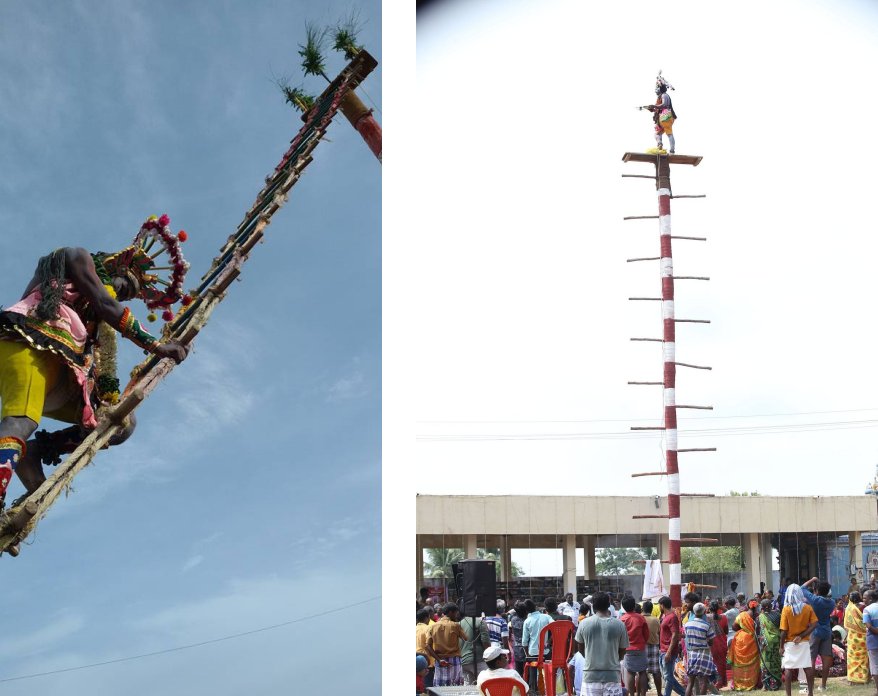
ARJUNA TAPAS
An early morning ritual in which Arjuna climbs a long pole representing
the Himalayas to commence penance praying for the mightiest weapon for
the final battle. This is another ritual in which the village women,
particularly childless actively participate. This is an occasion for
taking vow as well as fulfilling the vow taken for be getting a child.
|
|
MADUPIDI SANDAI (Retrieving of the Cattle)
When the exile of the Pandavas is drawing to a close Bhishma &
Dhronar and Dhuriyodhana invade Virate Kingdom and take away the cattle.
Pandavas retrieve them in a battle. This is one the most dramatic
rituals in which the entire cattle of the village representing the
virata kingdom is driven to the dry lake bed outside the village. The
enactment is in the lake. At the end, the cattle return home.
|
|
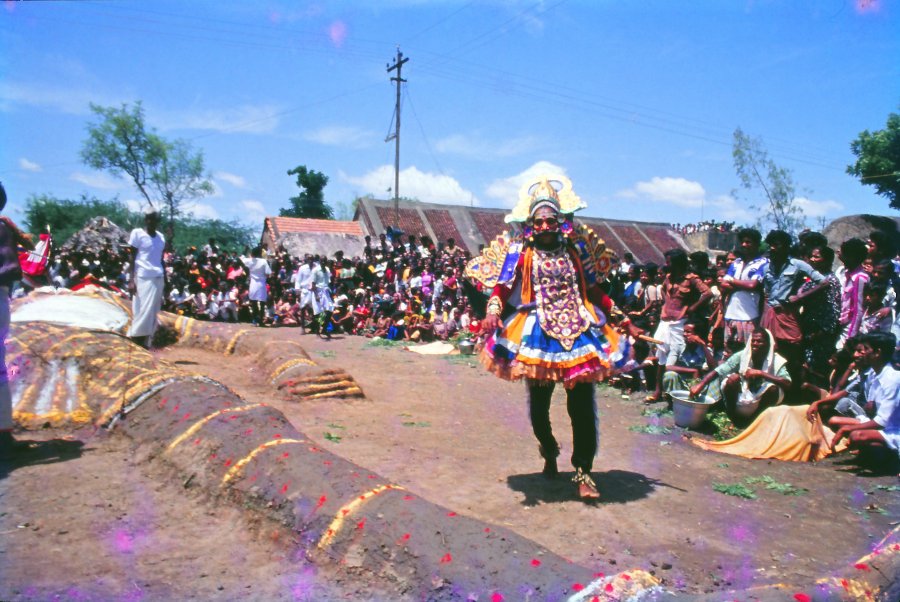
PADUKALAM
"Padukalam" the term associated with traditional Mahabharatha Koothu,
can be translated as "battlefield". It is actually the Koothu of the
final day in the ten day Bharathakoothu. On the 10th night, at dawn, at
the junction where Bheema and Duryodhana are facing each at the final
battle, Krishna enters to announce that the battle ought to be shifted
to a sanctified space where Parasurama and Karthaveeraujuna are said to
have fought each other.
The Final Act takes place in the morning of the eleventh day. At a time
fixed by the village elders, Koothu actors specially identified by these
elders begin to dance to the rhythm of the Parai drum. The ritual of
Padukalam begins. Bheema and Duryodhana fight each other through the
streets of the village. The entire village becomes the battlefield of
Kurukshetra. A thick rope is held in between the actors to prevent the
wrath of the characters assumed by them taking them over and to prevent
any untoward incident happening in consequence. But the actors covert
the device of the dividing rope into a theatrical device. The rope
facilitates the intensity of the anger of the two actors. The actors
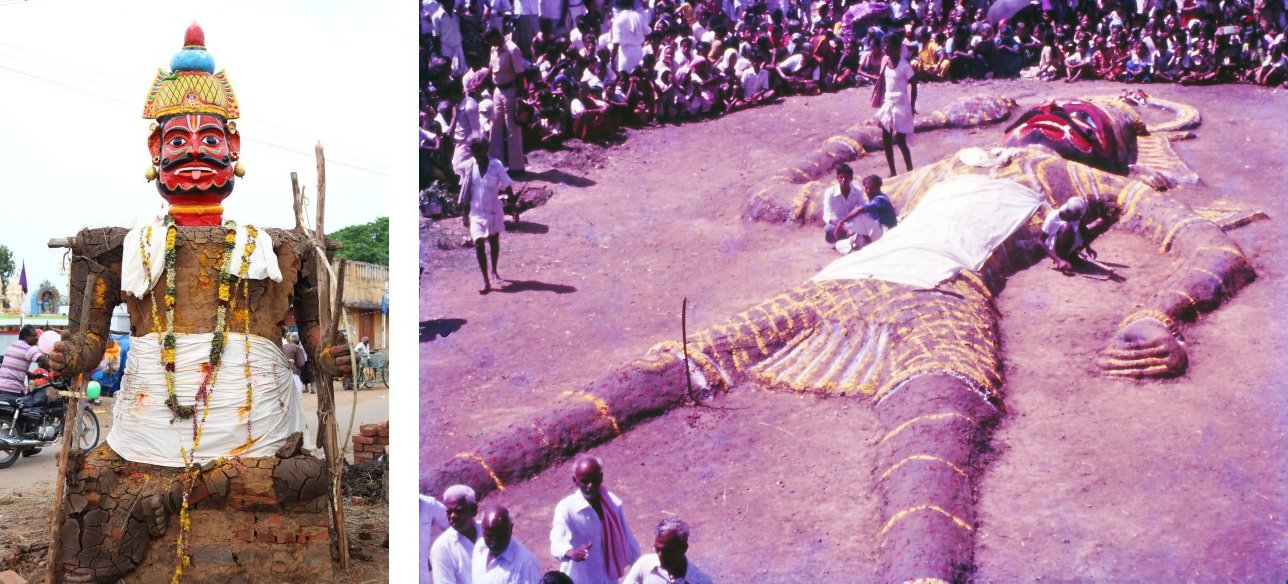
enter the area of Padukalam dancing to the beat of the drum Parai. A
giant statue of Duryodhana made of earth is lying in the open in front
of the Draupadi Amman temple for decades. The statue is not decorated
for the occasion and an earthen pot with blood red water has been
embedded in its right thigh. The two actors chase each other around the
state and as a final act, Bheema strikes his mace at the earthen pot.
The actor depicting Duryodhana writhes in pain and the battle is now
over. The blood red water is taken for smearing the hair of the idol of
Draupadi in the temple and for tying the hair up. The hair is then
knotted.
But then, with that, has the problem of war been knotted up? Is the
problem over? A woman in a black saree than enters the arena to mourn
the death of Duryodhana. She wails loudly beating her chest not only for
the death of Duryodhana but also for his misdeeds which where the cause
of his death as a warning to the large. The women onlookers of the
village make a comedy of her wailing and they also join her in their
wailing beating their chests. A jugal bandi ensues here. Rejoicing of
the death and the mourning of the death are depicted simultaneously
through this theatricality that involves the actor and the onlookers.
Some people who are observing austerities as the result of a penance
perform the death rituals for Duryodhana as the death rituals of their
own family. They wear clothes soaked in turmeric water and sit in small
trenches dug in the four corners of the Duryodhana state and cover
themselves with yellow cloth of turmeric. Turmeric water is then
splashed on them gently with Neem leaves.
|
|